Parenting
Parents Build... And Parents Break
July 15, 2026 · 3 min read
By: الأكاديمية
Parents may exert great effort in providing their children's material needs, but Tarbiyah is not limited to food, clothing, and education; it also includes building character, Iman, and morals. When certain educational mistakes occur repeatedly, their effects do not stop at childhood, but may extend across a person's entire life. For this reason, Islam urged bearing the responsibility of Tarbiyah with wisdom and awareness.
The absence of good example and its effect on children
Harshness and violence and their psychological and behavioural effects
Excessive indulgence and creating a dependent personality
Emotional neglect and being preoccupied away from children
Comparing children with one another and its effect on self-confidence
Weak Iman-based upbringing and its intellectual and behavioural effects
Constant criticism and excessive blame versus insufficient encouragement
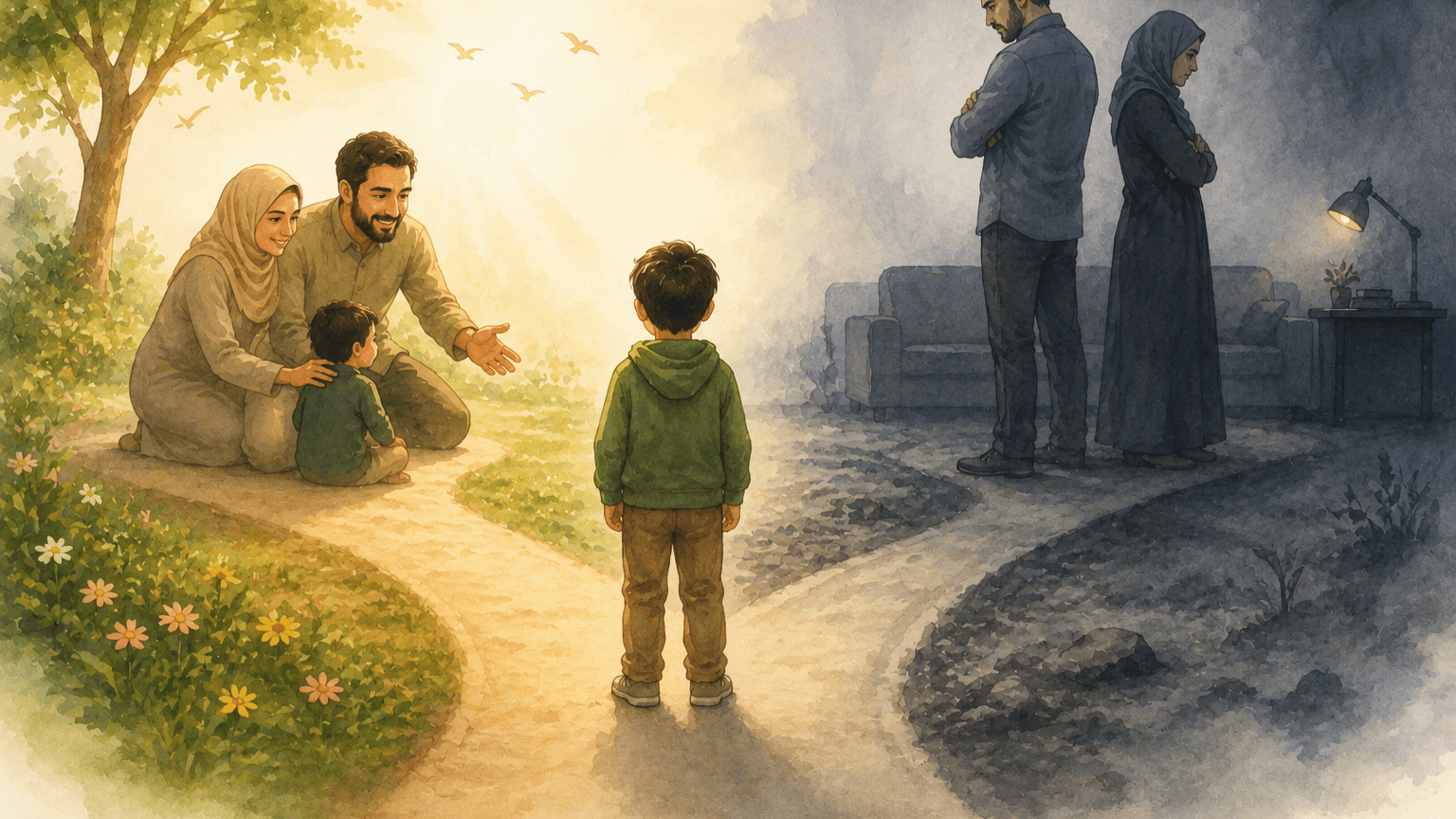
Contradiction between parents and its effect on children's stability
How can educational mistakes be corrected?
The Absence of Good Example
One of the most common causes of weakened parental influence is when a parent's actions contradict their words — asking children to be honest while not committing to honesty themselves, or urging them to pray while being lax in their own Salah.
This contradiction creates confusion in children and makes them less convinced by advice, because practical behaviour has a far stronger effect than words.
Excessive Harshness
Some parents believe that constant severity is the only path to Tarbiyah, while harshness often leads instead to fear, dishonesty, weak self-confidence, or rebellion in adulthood.
Islamic Tarbiyah calls for firmness disciplined by mercy — neither excessive leniency nor exaggerated punishment.
Excessive Indulgence
Just as harshness is harmful, excessive indulgence is no less dangerous, because it makes children unable to bear responsibility or face disappointment, instills in them a dependence on others, and weakens their capacity for patience and effort.
Balance between mercy and discipline is the ideal path to building a strong character.
Comparing Children with One Another
One of the common mistakes is comparing a child to his siblings, relatives, or peers, which breeds jealousy, envy, and a sense of inadequacy, and weakens his self-confidence.
The correct approach is for parents to view each child's abilities as distinct, and to encourage him to measure his progress against himself, not against others.
Being Preoccupied Away from Children
Parents may be physically present at home, yet absent from their children's lives due to constant preoccupation or excessive use of electronic devices.
A child who does not find dialogue and attention within his family may seek it outside, which increases the likelihood of being influenced by bad companionship or deviant ideas.
Neglecting Iman-Based Upbringing
Focusing solely on academic success while neglecting the building of one's relationship with Allah leaves children more vulnerable to instability when facing trials and pressures.
For this reason, the prophets were keen to instill creed and worship in their children's hearts, as Luqman did when advising his son, and as Ibrahim and Ya'qub, peace be upon them, were keen to instruct their children in Tawhid.
Excessive Criticism and Insufficient Encouragement
Constant criticism makes a child feel incapable no matter how hard he tries, while sincere encouragement helps raise his motivation and build his self-confidence.
This does not mean ignoring mistakes, but addressing them wisely, while highlighting and encouraging the positive aspects.
Many of the problems that appear during the teenage years have roots in mistaken educational approaches during the years of childhood. For this reason, parents reviewing their approach, correcting mistakes, and being diligent about good example, mercy, dialogue, justice, and Iman-based upbringing is among the most important means of protecting children and building stable characters capable of serving their religion and their society.