Parenting
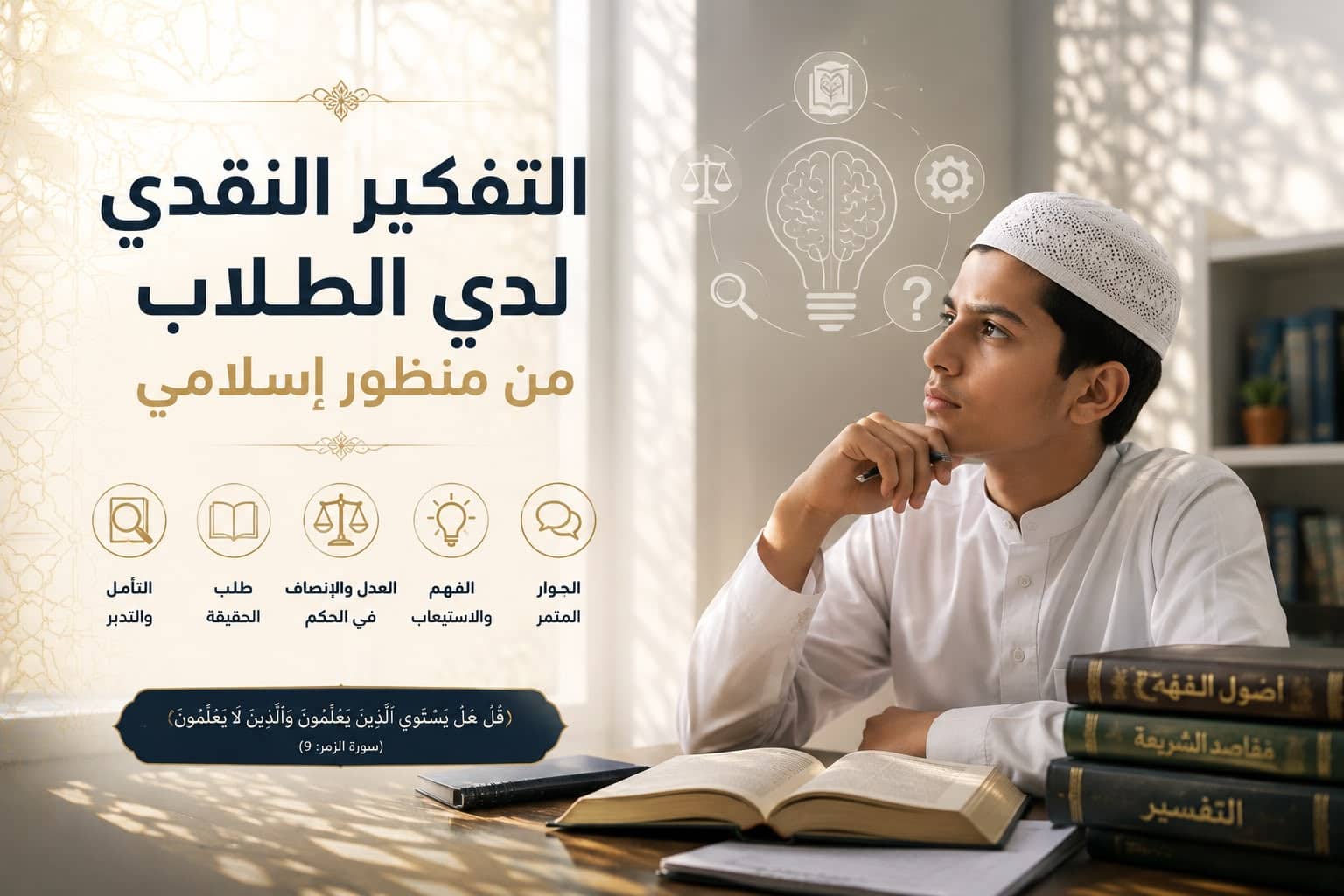
Critical Thinking Among Students from an Islamic Perspective
June 14, 2026 · 3 min read
By: الأكاديمية
In an age of accelerating information and intertwined sources of knowledge, critical thinking has become the cornerstone for building an aware generation capable of distinguishing truth from falsehood, making sound decisions, and contributing actively to society. From an Islamic perspective, critical thinking is not merely a mental skill—it is an educational and spiritual tool that refines religious and moral awareness, guides the student toward forming a sound understanding of reality, achieving justice, and strengthening individual and collective responsibility. It is a bridge linking reason and faith, transforming knowledge from mere information into active awareness that changes the self and society.
Critical Thinking in the Islamic Vision
Islamic Values That Enhance Critical Thinking
The Teacher's Role in Developing Critical Thinking
The Educational Environment and the Family
Practical Applications of Critical Thinking
Critical Thinking in the Islamic Vision
In the Islamic conception, critical thinking is built on a blend of rationality and value-based awareness, drawing on the Holy Qur'an, the Prophetic Sunnah, and the practices of the Companions and their followers, who embodied reflection and contemplation in their daily lives. A Muslim is called upon to use reason and reflection to understand God's laws in the universe, to distinguish between good and evil, and to evaluate information and events in accordance with Islamic values.
From this standpoint, critical thinking is seen as a natural extension of faith-based awareness: a deep understanding of knowledge is a path to self-elevation, a means of making sound ethical decisions, and a way of achieving the public good in society.
Islamic Values That Enhance Critical Thinking
Islamic values play a pivotal role in refining students' critical thinking skills, most notably:
Reflection and contemplation (tadabbur and tafakkur): Encouraging students to reflect on the verses of the Qur'an and the Prophetic Sunnah to understand their meanings and purposes, and to apply them in their lives.
Inquiry and research: Urging students to gather and analyze information before adopting any position, relying on both religious and rational evidence.
Responsibility and justice: Using thinking skills to evaluate facts and make fair decisions that consider the public good.
Creativity and independent reasoning (ijtihad): Encouraging students to generate innovative solutions to problems, within religious and ethical frameworks.
The Teacher's Role in Developing Critical Thinking
The teacher in Islamic education is a pivotal element in fostering critical thinking skills—not merely a transmitter of information, but a mentor and educational leader. This can be achieved through:
Adopting interactive teaching methods such as problem-solving, research projects, and structured debates.
Connecting lessons to contemporary reality, and presenting historical Islamic models of critical thinking in practice.
Encouraging dialogue and respecting questions and doubts, motivating students to analyze information with an open mind.
The Educational Environment and the Family
The educational environment plays a pivotal role in refining critical thinking skills. A school that values questions, research, and discovery creates a stimulating climate, while the family contributes to instilling values of intellectual curiosity and reflection from an early age. Through the integration of the school's and the family's roles, the student acquires a comprehensive awareness that makes a love of learning and critical thinking part of their character and identity.
Practical Applications of Critical Thinking
Critical thinking can be enhanced through specific educational activities, such as:
Studying and analyzing contemporary issues from an Islamic perspective.
Group projects that encourage research and problem-solving.
Writing critical essays that connect religious and scientific knowledge.
Organizing debates and decision-making simulations in realistic contexts.
Developing critical thinking skills among students from an Islamic perspective is not merely a cognitive goal, but a comprehensive educational project aimed at building an aware generation capable of facing the challenges of the age, making sound decisions, and contributing to the progress of its society. Islamic critical thinking links reason with values, transforming knowledge from mere information into integrated awareness that makes the student a thinker, a critic, and a responsible agent.
Related posts
June 14, 2026 · Parenting · 4 min read
Islamic Identity Between Challenges and Opportunities in the Twenty-First Century
June 11, 2026 · Parenting · 4 min read
Academic Discipline: The Cornerstone of Building Generations
June 10, 2026 · Parenting · 4 min read