Parenting
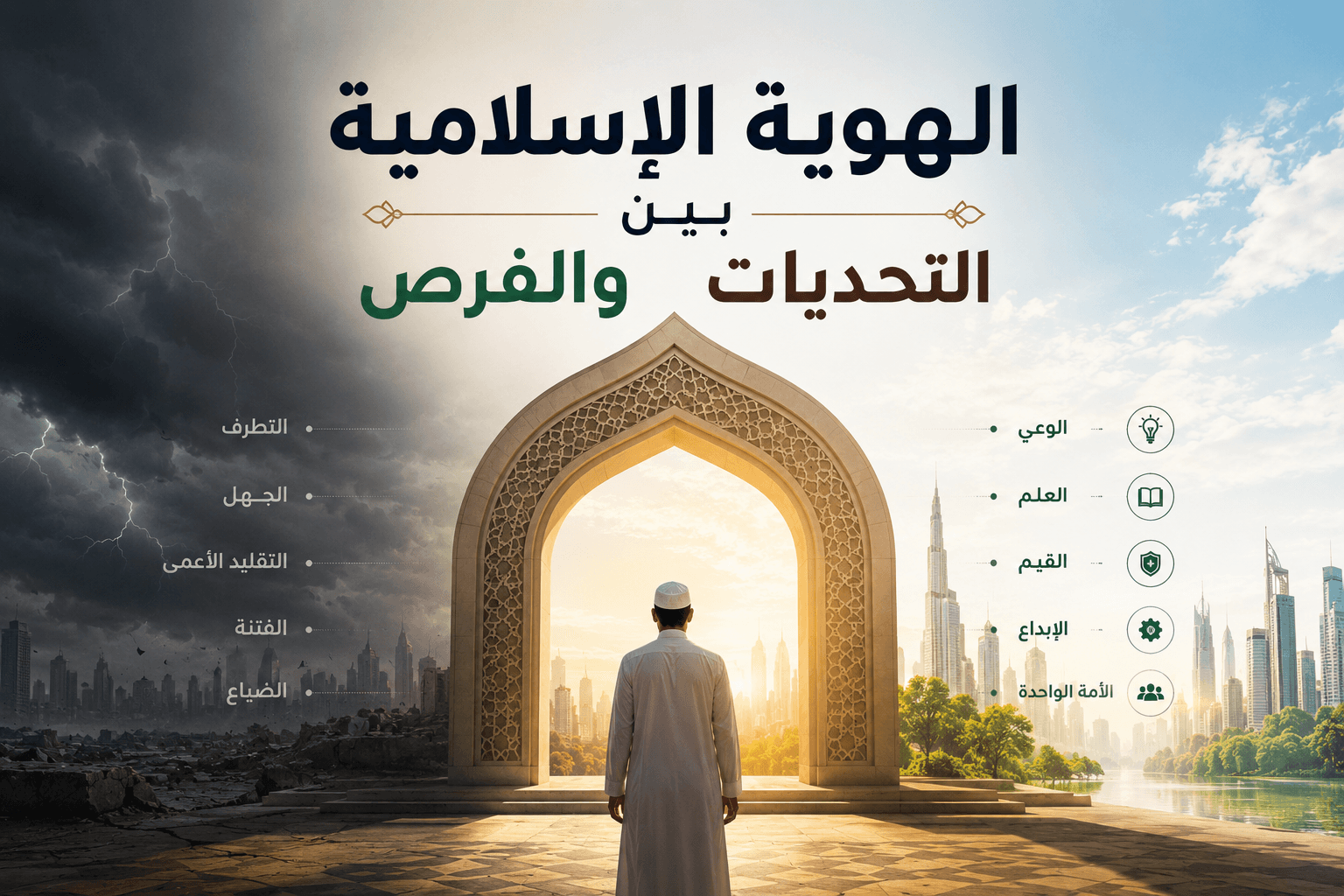
Islamic Identity Between Challenges and Opportunities in the Twenty-First Century
June 14, 2026 · 4 min read
By: الأكاديمية
In the twenty-first century, Islamic identity is no longer a mere religious or cultural affiliation in a static sense — it has become a dynamic civilizational project engaging with a rapidly transforming world, one in which digital globalization is interwoven and questions of meaning, belonging, and values are intensifying. Caught between the pressures of challenges and the expansiveness of opportunities, Islamic identity faces a historical test: how to preserve its essence while cultivating an effective presence in an open, borderless world.
• The Concept of Islamic Identity and Its Dimensions
• Contemporary Challenges Facing Islamic Identity
• The Latent Opportunities for Strengthening Islamic Identity
• Contours of a Renewed Discourse on Islamic Identity
The Concept of Islamic Identity and Its Dimensions
Islamic identity is a complex construct, shaped by the creed that defines the human being's cosmic worldview; the Sharia that governs his relationship with his Lord and with others; the values and ethics that regulate individual and collective conduct; and the language, history, and civilizational memory that grant the Ummah its self-awareness.
Islamic identity is not a rigid mold — it is a living entity capable of renewal: firm in its foundations, flexible in its means, and capable of engaging with diverse contexts without losing its doctrinal and ethical compass.
Contemporary Challenges Facing Islamic Identity
Cultural Globalization
Globalization has imposed a single cultural model built on consumerism, individualism, and the dismantling of reference frameworks — leading to the erosion of cultural and religious particularities. Islamic identity has come to face the threat of absorption into a universal culture that recognizes no constants and grants religious values no effective space.
The Digital Revolution and the New Media
Social media has reshaped collective consciousness and created multiple sources of knowledge and influence — many of which lack depth or credibility. Religious discourse has at times been reduced to rapidly consumable content, weakening the relationship between new generations and established scholarly authority.
Value Duality
Many Muslims — particularly youth — suffer from a duality between what they believe religiously and what they live in practice. This arises from the pressure of the prevailing Western model and the scarcity of contemporary Islamic models capable of practically embodying Islamic values in modern life.
Intellectual Challenges
These include waves of contemporary atheism, moral relativism, and the redefinition of foundational concepts such as the family, freedom, and the human being — in contexts that at times clash with the Islamic worldview concerning the universe and life.
The Latent Opportunities for Strengthening Islamic Identity
The Digital Space as a Tool of Empowerment
The digital world offers an unprecedented opportunity to disseminate Islamic knowledge, build trans-boundary learning communities, and present a contemporary educational and outreach discourse that addresses both mind and heart in the language of the age.
The Universality of the Islamic Message
In a world searching for justice and meaning, Islamic values — such as human dignity, solidarity, and the balance between the material and the spiritual — possess a genuine capacity to offer an ethical civilizational alternative, provided they are presented and embodied with excellence.
The Educational Awakening
Growing awareness of the importance of holistic education — which builds the human being intellectually, spiritually, and ethically — opens the way for reshaping Islamic identity through the family, educational institutions, and conscious pedagogical projects.
The Experience of Muslim Minorities
Muslim minority communities in the West have presented new models for reconciling religious belonging with active citizenship, and have contributed to the development of an identity discourse capable of coexistence without assimilation.
Contours of a Renewed Discourse on Islamic Identity
A renewed discourse on Islamic identity in the twenty-first century is characterized by:
• Transitioning from a discourse of defense to a discourse of construction and initiative.
• Linking identity to its civilizational function, rather than to abstract slogans.
• Presenting successful, real-world models that reflect Islamic values across the diverse spheres of life.
• Addressing youth in the language of questions rather than the language of guardianship.
• Combining legal authenticity with contemporary intellectual competence.
Islamic identity in the twenty-first century is not in conflict with the age — it is in conflict with the moral vacuum and the crisis of meaning. The more complex the world becomes, the greater the need for a clear identity that grants the human being meaning, guides him ethically, and connects him to his mission of stewardship upon the earth.
The true challenge does not lie in the abundance of influences — but in our capacity to transform them into opportunities, and to build a conscious Muslim whose roots run deep and whose horizons stretch wide.
Related posts
June 14, 2026 · Parenting · 3 min read
Critical Thinking Among Students from an Islamic Perspective
June 11, 2026 · Parenting · 4 min read
Academic Discipline: The Cornerstone of Building Generations
June 10, 2026 · Parenting · 4 min read