Aqeedah & Iman
Religious Education Between Stability and Development
June 14, 2026 · 3 min read
By: الأكاديمية
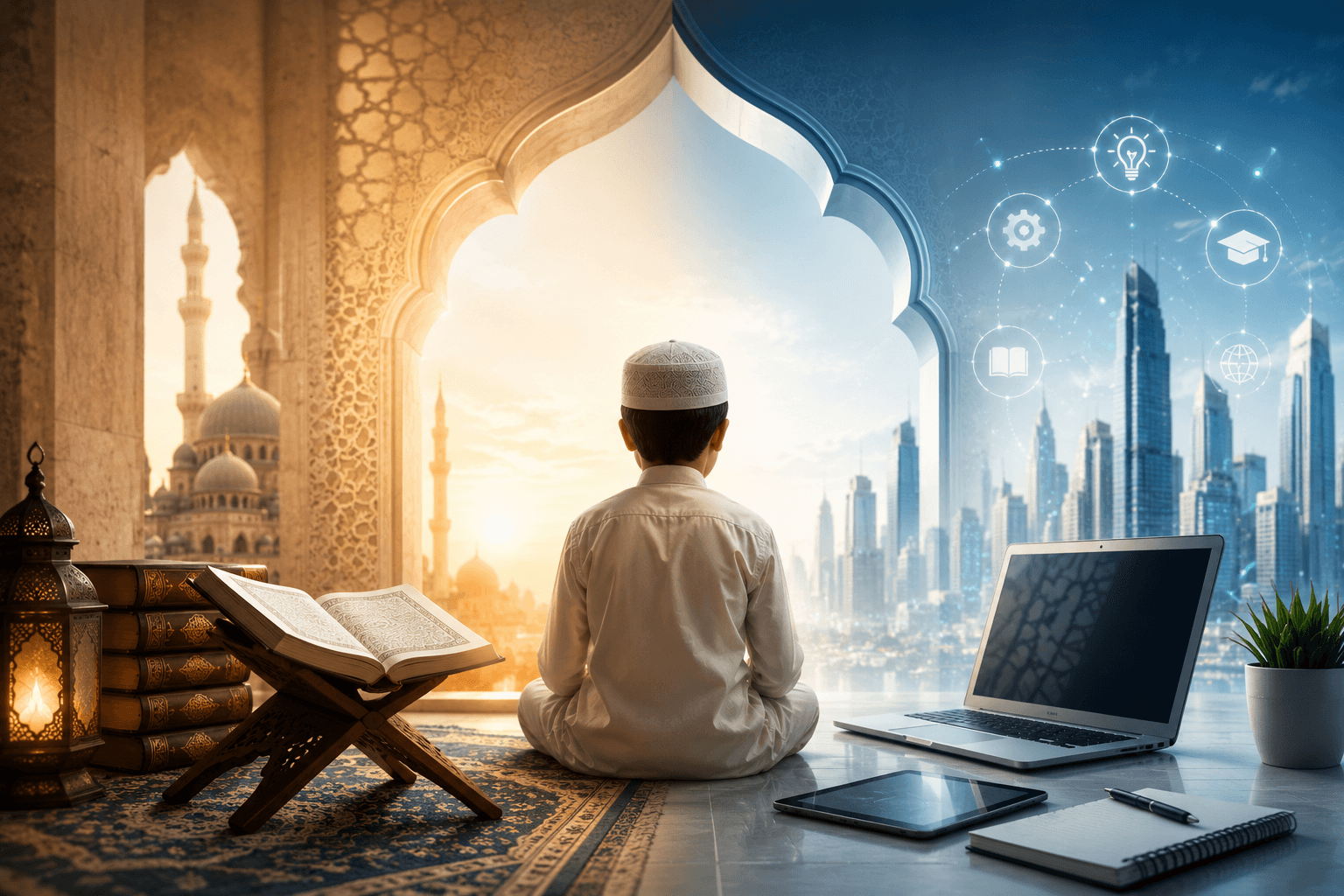
Religious education forms the solid foundation for building the faith-based and intellectual awareness of individuals and societies, and it is the natural extension of the mission of knowledge that has preserved the nation's identity and frame of reference throughout the ages. With the accelerating intellectual and cultural transformations in our contemporary world, the need has emerged to reconsider patterns of religious education in a way that achieves balance between preserving heritage and renewing its tools—hence the distinction between traditional religious education and modern reformist education.
Traditional Religious Education: Firm Roots and Preservation of the Trust
Modern Reformist Religious Education: Awareness of Reality and Methodological Renewal
Fundamental Differences Between the Two Approaches
Contemporary Islamic Studies Academies
Traditional Religious Education: Firm Roots and Preservation of the Trust
Traditional religious education relied on a well-established academic methodology aimed at preserving the religious sciences and protecting them from distortion, through direct learning from scholars, the study of authoritative texts and their commentaries, and adherence to inherited jurisprudential and creedal schools. This model contributed to producing well-grounded scholars, preserving the chain of scholarly transmission, and ensuring the continuity of religious knowledge across generations.
However, in some of its contemporary applications, this model has faced challenges represented by the dominance of rote instruction over understanding, weak development of analytical and critical thinking skills, and limited connection between religious knowledge and the realities and changes of contemporary life.
Modern Reformist Religious Education: Awareness of Reality and Methodological Renewal
Modern reformist religious education emerged as a conscious response to these challenges, without compromising fundamentals or constants. It proceeds from the centrality of religious texts, while deepening purpose-oriented (maqasid-based) understanding, connecting rulings to their underlying reasoning, and activating religious knowledge to address the intellectual and social issues of the age.
This approach is distinguished by the development of curricula and teaching methods, moving from mere memorization to building understanding, analysis, and deduction, while broadening the student's horizons through benefiting from the humanities and social sciences, establishing a culture of scholarly dialogue, and employing modern educational technologies in an interactive and inspiring learning environment.
In this model, heritage is not viewed as an obstacle but as a living scholarly treasure that requires a conscious, methodical reading—one that distinguishes between the constant and the variable, and keeps the Islamic methodology capable of giving and renewing itself.
Fundamental Differences Between the Two Approaches
The difference between traditional religious education and modern reformist education appears across several key areas, most notably:
Educational methodology: From a focus on transmission and memorization to combining transmission with understanding and analysis.
Scholarly purpose: From preserving heritage to activating it in real life.
The learner's role: From a passive recipient to an active partner in the learning process.
The relationship of knowledge to reality: From abstraction to addressing contemporary issues with a conscious, legally grounded vision.
Educational tools: From classical methods to modern educational environments and digital technologies.
Reform in religious education is not a break from the past, but a conscious extension of it—one that combines authenticity with renewal, and balances stability with development. From here, contemporary Islamic studies academies play a pivotal role in providing firm religious education that is alive to its reality, shaping a balanced scholarly character capable of deep understanding of religion, positive engagement with the times, and contributing to the nation's scientific and moral renaissance.
Related posts
June 14, 2026 · Aqeedah & Iman · 3 min read
How Knowledge of God Shapes the Upright Individual and the Balanced Society
June 14, 2026 · Aqeedah & Iman · 4 min read
The Creed of Tawhid: The Silent Foundation for Building the Faith of the Child and the Awareness of the Adolescent
June 11, 2026 · Aqeedah & Iman · 4 min read